


Powder metallurgy and metal extrusion both convert raw metal into usable engineering shapes, but they follow fundamentally different production routes. Powder metallurgy compacts metal powder into a discrete shape and bonds the particles through sintering, while extrusion forces a solid billet through a shaped die to produce a long profile with a substantially constant cross-section.
The comparison of Powder Metallurgy vs Extrusion matters because each route produces different geometry, density, and mechanical behavior. Process selection depends on part geometry, material, required density, production volume, tolerance, and total manufacturing cost rather than on a single performance factor.
Contents
What Powder Metallurgy and Extrusion Are?
Powder Metallurgy Production Principles
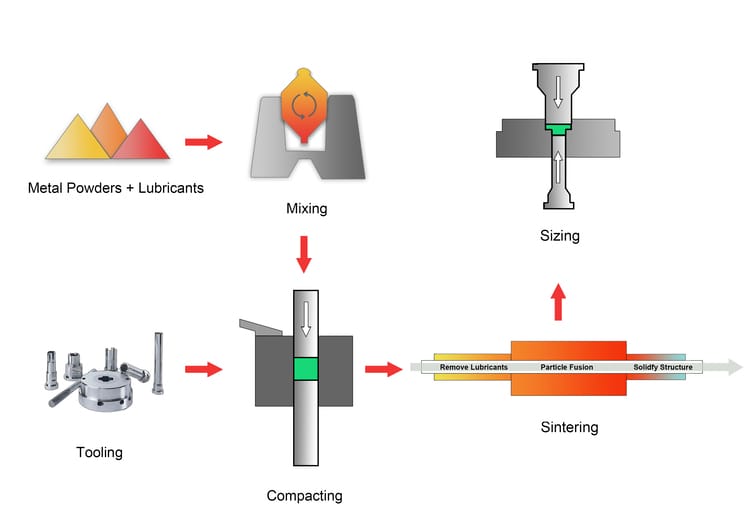
Powder metallurgy starts with metal powder rather than solid stock. The powder is blended with alloying elements and a lubricant, then pressed inside a rigid die to form a green part.
Compaction pressure determines green density and dimensional consistency. The green part is then sintered below the base metal melting point, bonding particles through diffusion.
Sizing, coining, or machining may follow to reach final dimensions on a discrete component.
Metal Extrusion Production Principles
Metal extrusion begins with a solid billet loaded into a container. Ram pressure forces the heated or room-temperature billet through a die opening, and the metal flows plastically into the die profile. Direct or indirect extrusion methods route metal flow differently, but both rely on deformation rather than particle bonding.
The resulting profile exits continuously, then undergoes cooling, stretching, straightening, and cutting to length.
Differences Between Powder Metallurgy and Extrusion
The two processes diverge in feedstock, forming principle, and output form. Powder metallurgy process compacts and sinters powder into a near-final discrete shape, while extrusion plastically deforms a solid billet into a continuously repeated profile. These differences influence tooling, density, and downstream operations throughout the production chain.
| Factor | Powder Metallurgy | Extrusion |
|---|---|---|
| Feedstock | Metal powder blend | Solid billet |
| Forming principle | Compaction and sintering | Plastic deformation through a die |
| Output form | Discrete component | Continuous profile |
| Typical geometry | Axial features, gears, hubs | Constant cross-section shapes |
| Density | Often retains residual porosity | Near full theoretical density |
| Tooling | Component-specific compaction die | Profile-specific extrusion die |
| Production pattern | Repeated press cycles | Continuous profile runs |
| Typical products | Gears, bushings, filters | Rails, tubes, heat sinks |
These distinctions carry forward into material selection, geometry limits, and cost structure, which are examined in the following sections.
Material Compatibility
Materials Used in Powder Metallurgy
Iron-based alloys dominate conventional structural powder metallurgy, supplemented by carbon steels, low-alloy steels, stainless steels, copper alloys, bronze, and nickel-based materials. Tungsten-based and soft magnetic powders serve specialized applications.
Suitability depends on powder compressibility, particle shape, oxidation sensitivity, and sintering response.
Alloying method and required final density also influence which powder system is practical for a given part.
Materials Used in Extrusion
Aluminum alloys are widely extruded because of their formability, moderate flow stress, and broad use in profile applications. Copper alloys, magnesium alloys, steel, stainless steel, nickel alloys, and titanium alloys are also extruded under appropriate temperature and press conditions.
Suitability depends on billet ductility, flow stress at extrusion temperature, extrusion ratio, oxidation behavior, and die wear. Higher-strength alloys demand greater press force and more durable tooling.
Part Geometry and Design Freedom
Achievable Geometries in Powder Metallurgy
Conventional pressing produces near-net-shape parts with external gear teeth, internal splines, hubs, flanges, steps, pockets, axial holes, and oil grooves. Uniaxial compaction favors features aligned with the pressing and ejection direction. Unrestricted undercuts, arbitrary side holes, and complex transverse cavities cannot be formed directly and typically require secondary machining or specialized tooling arrangements.
Achievable Geometries in Extrusion
Extrusion produces solid and hollow profiles, channels, rails, frames, tubes, heat sink fins, and thin-wall sections that continue along the extrusion direction. Cross-sections cannot change along the profile length, and isolated pockets, transverse holes, or local gear teeth cannot form directly. Cutting, drilling, milling, or bending converts the extruded profile into a finished component.
Dimensional Accuracy and Tolerances
Powder metallurgy dimensional control depends on die dimensions, powder fill consistency, green density distribution, sintering shrinkage, and tool wear.
Sizing or coining after sintering tightens critical dimensions. Once tooling and process parameters stabilize, high-volume runs achieve strong repeatability across large batches.
Extrusion dimensional control depends on die design, billet temperature, metal flow uniformity, extrusion speed, and cooling rate. The cross-section repeats along the profile, but straightening, stretching, and cutting are commonly needed to meet final length, straightness, and flatness requirements. Wall thickness variation can occur in thin sections, particularly in longer runs or asymmetric profiles.
Density and Porosity Differences
Conventional press-and-sinter powder metallurgy typically retains some residual porosity, which varies with powder distribution, part height, compaction pressure, and geometry transitions. Density can be increased through repressing, sizing, coining, or copper infiltration, and further increased through powder forging or hot isostatic pressing where justified by application requirements.
Extruded metal generally reaches near-full theoretical density when sound billet material and controlled processing are used, though extrusion introduces grain elongation, texture, and directional residual stress. Controlled porosity in sintered parts is not purely a limitation; it supports oil retention in self-lubricating bearings, fluid filtration, gas diffusion, and sound attenuation, functions that extrusion cannot replicate.
Mechanical Properties Comparison
Powder metallurgy properties depend on alloy composition, powder quality, compaction pressure, sintered density, pore distribution, sintering atmosphere, and any secondary heat treatment or densification step. Pore structure influences fatigue resistance, impact toughness, and ductility more than it influences hardness or wear resistance in many applications.
Extrusion properties depend on alloy grade, billet condition, extrusion temperature, extrusion ratio, deformation history, grain orientation, cooling rate, and temper. A fully dense extruded alloy often provides greater ductility and fatigue resistance than a conventional porous sintered material of broadly comparable composition. However, the outcome depends on alloy selection, achieved density, heat treatment, part geometry, and loading direction rather than on process alone. Powder metallurgy can offer superior functional performance where controlled porosity, magnetic response, or tailored composition outweighs the value of maximum bulk strength.
Material Utilization and Waste
Powder metallurgy forms parts close to final geometry, which limits machining allowance and chip generation. Losses arise instead from powder yield during production, powder recovery during handling, rejected green parts, and sintering distortion that requires rework. Overall scrap is often lower than machining from solid bar stock for geometrically complex parts.
Extrusion achieves efficient material use for long profiles cut to length, but billet butt scrap, start-up scrap, profile end trimming, and rejected sections all contribute to loss. Metal scrap from both extrusion and downstream machining is commonly recyclable. A complex discrete component generally favors powder metallurgy for yield, while a long constant-section product generally favors extrusion.
Production Speed and Volume Suitability
Powder Metallurgy Production Rates
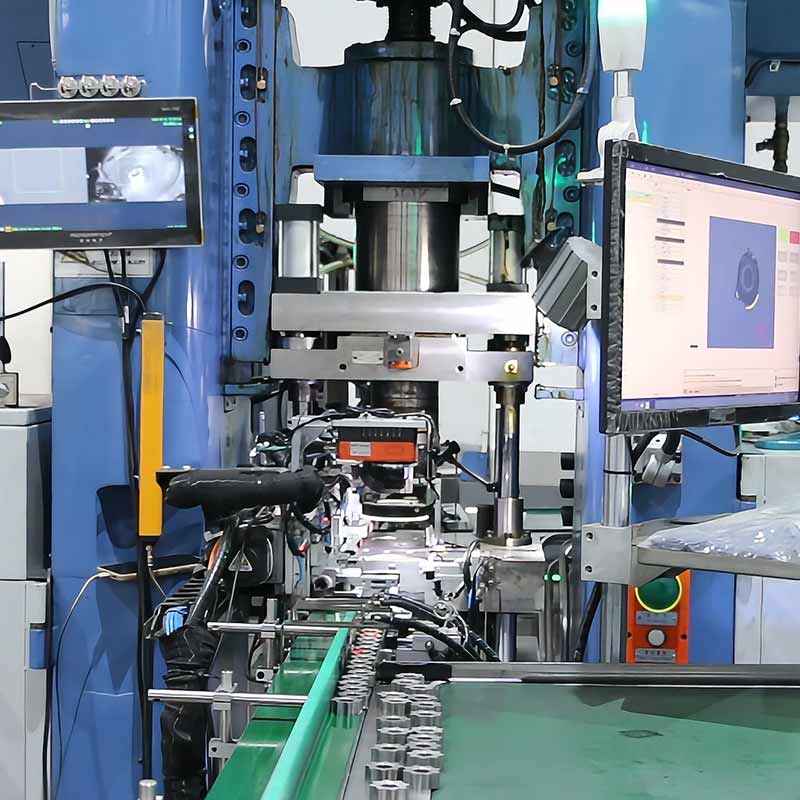
Fast press cycles, multi-cavity dies, automated powder filling, and automated ejection support high repeatability across large batches. Continuous sintering furnaces and batch tracking maintain consistency once tooling and process parameters are established. This production pattern commonly suits medium and high volumes of identical discrete parts, such as gears or sintered bushings.

Extrusion Production Rates
Extrusion output depends on billet size, press capacity, extrusion speed, and profile length, with cooling, stretching, straightening, and cutting following each press cycle. Die and billet changeover time affects overall throughput. This process commonly suits long production runs of a single repeated profile rather than frequent product changes, since neither process is automatically economical at low volume without sufficient quantity to justify dedicated tooling.
Tooling Investment and Cost Structure
Powder metallurgy tooling includes punches, die cavities, and core rods sized to the final part geometry, often representing a substantial upfront investment for complex multi-level components. Ongoing costs include powder price, press time, sintering energy, sizing, and any required heat treatment or machining.
Extrusion tooling centers on a profile-specific die, which may cost less than a complex powder metallurgy compaction tool for a comparable part. However, total cost can rise when an extruded blank requires extensive cutting, drilling, or machining to reach final geometry. Powder metallurgy may justify higher component-specific tooling when large quantities of near-net-shape parts reduce downstream processing. Comparing raw material cost, conversion cost, secondary processing cost, and scrap cost together gives a more accurate total than tooling price alone.
Secondary Operations Required
Sintered parts often need sizing, coining, deburring, heat treatment, or oil impregnation to reach final tolerance and functional performance. Plating or coating may follow when corrosion resistance or surface hardness is required. Near-net-shape manufacturing reduces machining volume but does not eliminate it for tight-tolerance features.
Extruded profiles commonly require straightening, saw cutting, drilling, milling, or bending to create transverse holes, threads, or local features that the extrusion process cannot form directly. Anodizing, painting, or polishing may follow for surface protection or appearance. Extrusion produces a shaped blank rather than a finished, assembled component in most applications.
Surface Finish Characteristics
Sintered surfaces commonly show powder particle texture, open surface porosity, tool marks, and occasional sintering discoloration. Machining or grinding after sintering improves local surface quality where needed. Final appearance depends heavily on powder characteristics and tool condition rather than sintering alone.
Extruded surfaces commonly show longitudinal die lines, oxide scale, and occasional handling or straightening marks, particularly near profile ends. Surface quality depends on material, die condition, lubrication, and processing temperature. Neither process produces a universally superior as-formed surface; both rely on secondary finishing such as machining, polishing, or anodizing when appearance or corrosion resistance requirements are strict.
Industrial Applications
Common Powder Metallurgy Applications
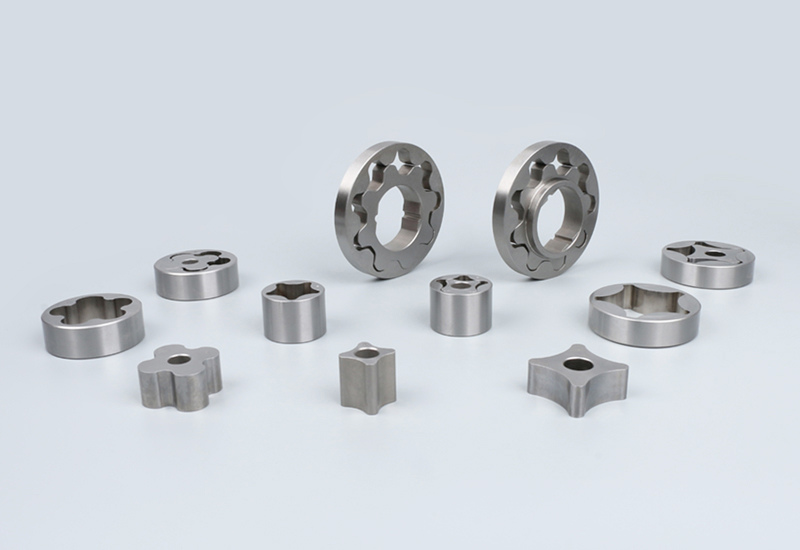
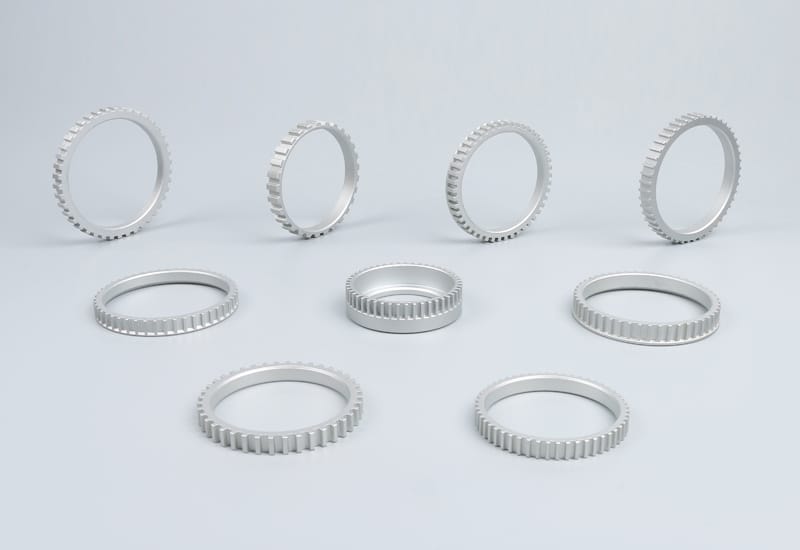
Powder metallurgy suits components that benefit from near-net-shape geometry, high production volume, and controlled porosity. Common examples include powder metal gears, sprockets, pulleys, oil pump rotors, bearings, bushings valve guides, ABS sensor rings, structural brackets, and sintered filters. Material blending and oil impregnation extend functional performance beyond what solid stock machining typically offers.
Common Extrusion Applications
Extrusion suits products requiring long continuous length, constant cross-section, and thin walls. Common examples include structural rails, frames, channels, window profiles, heat sinks, pipes, tubes, and electrical conductors. Longitudinal cavities and thermal management features benefit directly from the continuous profile format that extrusion provides.
Automotive Applications Comparison
Powder metallurgy commonly serves compact automotive components such as transmission parts, timing sprockets, oil pump rotors, VVT components, valve guides, bearing components, ABS sensor rings, and seat adjustment parts, where geometry and volume favor near-net-shape pressing. Extruded automotive components commonly include aluminum structural rails, battery trays, battery enclosure sections, heat exchanger tubes, crash management profiles, and cooling channels, where long structural or thermal sections are required. The two processes typically serve different component categories rather than competing for the same part.
Sustainability Considerations
Environmental performance depends on the complete production route rather than the forming step alone. Powder metallurgy can reduce machining and associated chip generation because parts form close to final shape, but powder production itself carries its own energy demand. Extrusion can achieve efficient material use for long profiles and supports lightweight structural design, particularly in aluminum applications, while billet production and press heating require significant energy input. Scrap recyclability, recycled content, energy mix, production volume, and component service life all influence the overall environmental outcome, so neither process holds a universal sustainability advantage.
Limitations of Powder Metallurgy
Conventional uniaxial pressing cannot form every three-dimensional feature directly, and tool withdrawal requirements restrict undercuts and certain transverse geometries. Additional constraints affect process planning and part design.
- Dedicated compaction tooling requires sufficient production volume to justify investment.
- Part height and projected area are limited by available press capacity.
- Density gradients can develop across complex or tall geometries.
- Residual porosity can affect ductility, fatigue resistance, and leak tightness.
- Powder handling requires attention to flow consistency, segregation, and oxidation control.
Limitations of Extrusion
Extrusion depends on a constant cross-section along the profile length, which restricts the geometries it can produce directly. Additional constraints influence die design and downstream processing.
- Profile geometry must remain consistent along the extrusion direction.
- Extrusion ratio and billet size limit achievable wall thickness and section complexity.
- Press capacity and die design limit maximum profile dimensions.
- Distortion such as twist or bow may require straightening after extrusion.
- Transverse features still require separate machining operations.
Can Powder Metallurgy Replace Extrusion?
Powder metallurgy and extrusion generally serve complementary roles rather than interchangeable ones. A direct comparison becomes relevant only when a component could reasonably be produced either as a near-net-shape sintered part or as a section cut and machined from an extruded profile. The better route depends on part geometry, profile length, machining allowance, material waste, tooling cost, annual volume, required density, mechanical properties, tolerance, and surface finish. Powder metallurgy cannot replace long constant-section structural profiles, and extrusion cannot replace discrete parts with axial gear teeth or controlled porosity.
Process Selection Guide
Selecting between the two processes requires weighing geometry, material, volume, and performance requirements together rather than relying on a single criterion.
- Choose powder metallurgy for large quantities of identical discrete parts such as gears or rotational components with integrated axial features.
- Choose powder metallurgy when controlled porosity, self-lubrication, or tailored powder composition is required.
- Choose extrusion for long profiles with constant cross-sections, thin walls, or hollow longitudinal sections.
- Choose extrusion for structural rails, frames, heat sinks, or tubes requiring high-density ductile material.
- Evaluate material availability, annual demand, tooling budget, target density, tolerance, and secondary machining before finalizing the decision.
Neither process should be selected based on material type alone or on the assumption that one method universally outperforms the other across every requirement category.
FAQ
Is Powder Metallurgy Cheaper than Extrusion?
Cost depends on part geometry, production volume, tooling investment, and secondary processing rather than process type alone. Powder metallurgy can lower unit cost for complex discrete parts made in high volume, since machining is reduced. Extrusion can lower cost for long constant-section profiles produced in bulk. Comparing total manufacturing cost, not tooling price alone, gives an accurate answer for a specific component.
Which Process Produces Stronger Parts?
Strength depends on alloy selection, achieved density, heat treatment, and part geometry rather than process alone. Fully dense extruded metal often shows higher ductility and fatigue resistance than a porous sintered equivalent. However, powder metallurgy parts with controlled density and appropriate heat treatment can meet demanding structural requirements. Neither process guarantees superior strength in every application.
Can Extrusion Produce Complex 3D Shapes Like Powder Metallurgy?
Extrusion cannot produce shapes that change along the profile length, isolated pockets, or transverse holes directly. It is limited to constant cross-sections formed by the die. Powder metallurgy compacts three-dimensional discrete geometry, including gear teeth and axial features, within the constraints of uniaxial pressing. Secondary machining is needed on extruded parts to add local three-dimensional features.
Which Process is Better for High Volume Automotive Parts?
The better process depends on component type rather than volume alone. Powder metallurgy suits compact rotational or functional parts such as gears and bearings produced in high volume. Extrusion suits long structural or thermal sections such as battery enclosures or heat exchanger tubes. Both processes support high-volume automotive manufacturing but for different component categories.