


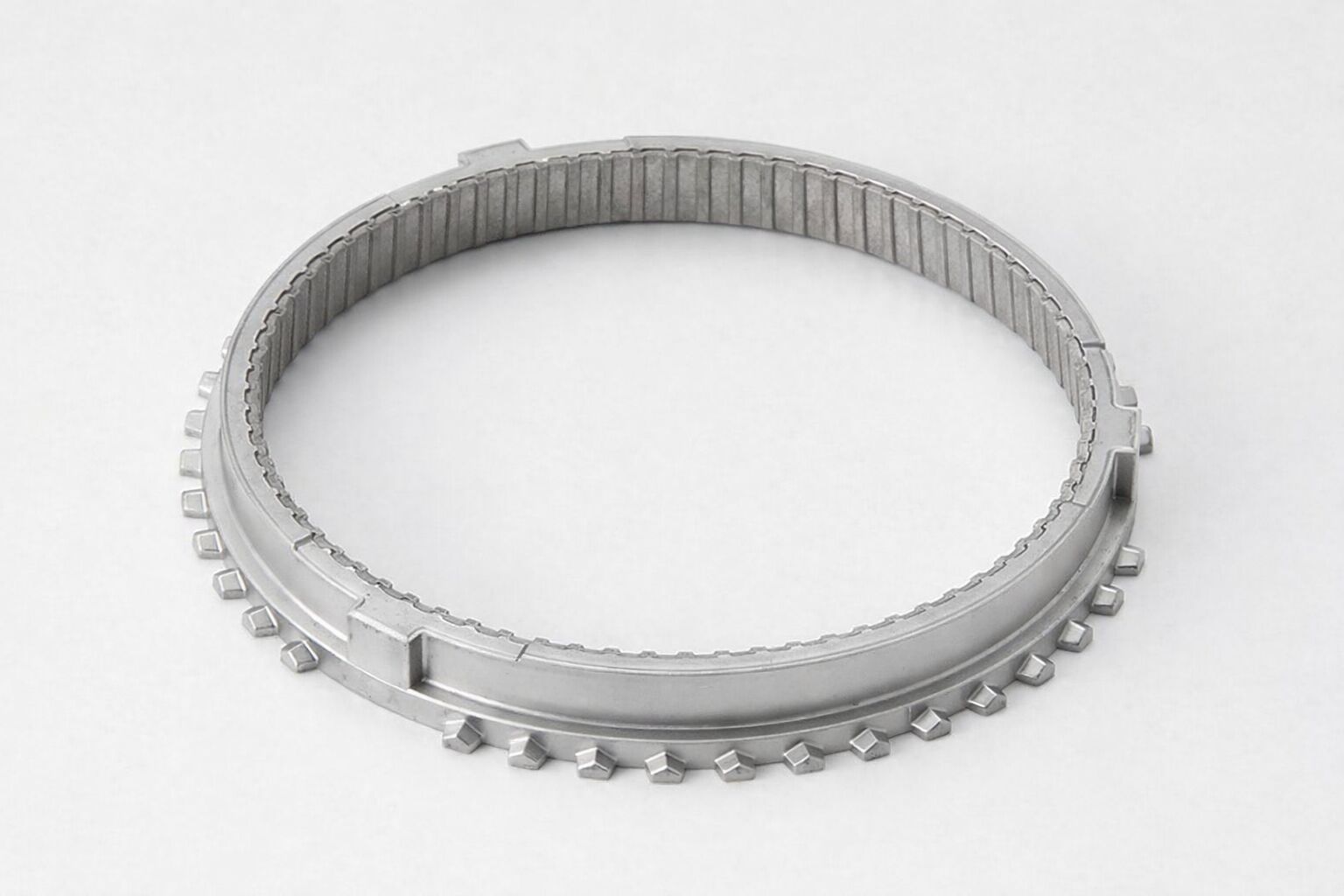
The synchronizer systems of heavy-duty transmissions work by applying torque with high loads, frequent cycle shifting and thermal shifts. They are designed to equalize the speed of rotating parts prior to engagement, which minimizes shift shock and tooth wear. The cone ring, and more specifically the synchronizer ring, accomplishes laying out the frictionally engaging surface which allows such speed matching.
With the engine torque of commercial vehicle growing and service condition going for longer mileages, the synchronizer ring must present steady friction-torque, resist to mechanical wear and remain dimensionally precise. Traditional forged-steel rings can require major machining, and may have performance characteristics which vary with load. Powder metallurgy (PM) is an alternative manufacturing process to manufacture complex parts having controlled density gradient and good mechanical properties for heavy duty applications.
Contents
Synchronizer Cone Ring Functional Characteristics
The friction torque is produced fromthe synchronizer ring by which two gears are connected to have same speed. Its tapered surface contacts the mating part, and must press that mating part with high force.
Cycling Sliding, Rapid Temperature Change and Time Dependent Loadings require a compromise between hardness, toughness and dimensional stability. If the structure becomes viscous, deforms in some regions or experiences breakdown of frictional uniformity, shifting with synchronizer can be hard, too much torque cannot be released and wear may occur at an early stage. Thus a stable microstructure and plane surface properties are required.
Metal Powder for Synchromesh Rings
More typically, in PM synchronizer rings a Fe–Mo–Ni–Cu powder formulation of sintered diffusion-alloyed types is used. A customary system will contain Mo for hardenability, Ni for toughness, Cu due to sintering response and graphite additions to balance the carbon content. A little bit of internal lubricant will enhance flowability and ejection from die. he alloying elements diffuse evenly during sintering, forming a fine pearlite matrix in the ring body. This shape provides stability in dimensions and enables the areas to be hardened, which form martensic structures at heat treatment.
Powder Metal Manufacturing Process for Synchronizer Rings
The powder metallurgy manufacturing process of synchronizer rings follows a series of controlled processing steps.
Powder Blending
The production process consists of first mixing the diffusion-alloyed iron powder with graphite (≈0.8 wt%) and a lubricant (≈0.3 wt%). The uniform mixture of the alloying element facilitates consistency in both densification and heat treatment.
Compaction
Compaction process under a high-tonnage press, with multi-floating die system, is implemented. The cone surface, indentations and central bore are produced during pressing in this tooling system. The die can be filled to about 42mm and the vibration assisted feeding promotes uniform packing. The compacting pressure is generally in the range of 600 -700 MPa. In this way, the green density reaches about 6.80-6.90 g/cm³ in a ring body and approximately 6.85-6.95 g/cm³ at positions with higher load carrying capacity provided for comparatively thereto。
Sintering
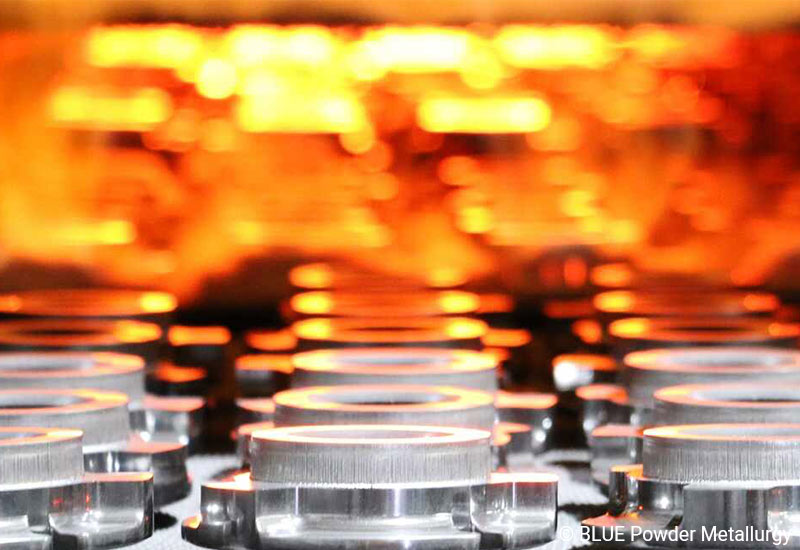
The workpiece is subjected to a staged heat cycle at sintering in an inert atmosphere. Binders and lubricants are burnt out at an approximate 680 °C, whereupon the rings are pre-sintered at a temperature of around 900 °C in advance of entering the main sintering plateau temperature of some ~1120 °C when regions for molten copper infiltration is defined within a ring, to increase local densities to about 7.45–7.55 g/cm³. This selective densification reinforces the regions that undergo maximum mechanical action in synchroniser.
Cooling is controlled to prevent any thermal distortion and in a manner which will condition the material for additional hardening. A short dwelling around 860 °C contributes to ensuring a homogeneous temperature of the ring just before final cooling.
Secondary Operations
Heat Treatment
Induction heat treatment is used to harden the friction surface. The ring has a rotation speed of 40 r/min and is operated by a short–high energy pulse of ∼600 A for ∼3 s followed by active chilling. This results in a 0.6–0.8 mm deep martenistic layer with surface hardness of around HRC 27 to 35.
CNC Machining
Dimensional tolerance on the conical face, pin holes, and end faces is determined by final machining. The assembly is finalized by connecting a carbon-fiber friction lining, having an approximate thickness of 0.65 millimeter, to the outer cone surface.
Steam Treatment
After sintering and controlled cooling, steam treatment is applied to the synchronizer ring surface. The component is exposed to superheated steam at elevated temperature, forming a thin and dense iron oxide layer. This oxide layer improves surface stability, wear resistance, and friction consistency, while also providing basic corrosion protection.
Mechanical and Physical Properties
PM synchronizer rings have a density gradient designed to suit load distribution. A pearliticcore is developed with martensitic sections in the treated areas when subjected to induction treatment. These include the high torques in combination with repetitive engage stresses typical of commercial vehicles.
The table below shows the mechanical properties of PM synchronizer cone rings.
| Property | Typical Value |
|---|---|
| Density (body) | 7.47 g/cm³ |
| Surface Hardness | ~HRC 30 |
| Highest Tensile Strength | ~619 MPa |
| Matrix Structure | Fine pearlitic diffusion alloy |
| Hardened Zone Depth | ~0.6–0.8 mm |
PM synchronizer rings have a reliable performance under the cyclic loading of shift. Its Hardened face remains frictionally sound and resists polishing.
Copper-infiltrated areas will not compress or distort under stressful abuse. Stability in dimensions is maintained after thermal cycling keeping cone engagement consistent.
The densification gradient and the well-controlled heat treatment in PM processing prevent failure modes present in conventional rings, such as localized bending or softening.
Comparative with Conventional Manufacturing
Synchronize rings made of 40Cr steel by forging or turning need many processing procedures with more waste materials and higher cost. Their microstructures can significantly differ from batch to batch, which has an influence on the long-term behavior of synchronizers.
Sintered synchronize rings, however, compound their geometry into most of the compacting. Machine time is minimized, dimensional repeatability is enhanced, and density can be customized in the most critical areas of performance. These benefits render PM particularly effective for high-volume heavy-duty transmission applications.
Performance for PM synchronizer rings is based on alloy design, selective densification, and controlled thermal processing. Superior dense formations in critical zones increases load carrying ability and a pearlitic core reduces any shape shifting during long service. Harmonization Induction hardening provides a tough friction surface, for long service life and smooth synchronisation.
Powder metallurgy serves as a dependable, cost-efficient, and proven process for manufacturing synchronizer cone rings such as are employed in heavy-duty transmissions.