
Air Compressor Piston
BLUE supplies high quality air compressor pistons designed for consistent compression performance, low friction, and long service life across residential and industrial compressor platforms. Our powder metal pistons provide stable mechanical properties, uniform density, and precise dimensional control, which support smooth piston movement and efficient air sealing. Standard P/M piston models are available with no mold fees.
What is an Air Compressor Piston?
An air compressor piston is the moving component inside a reciprocating compressor that compresses air within the cylinder. It travels up and down as the crankshaft rotates. During the downstroke, it draws air into the cylinder, and during the upstroke, it compresses the air and forces it into the discharge line.
The compressor piston works with the piston rings, connecting rod, and cylinder to create a sealed compression chamber. Its motion determines the compressor’s displacement, efficiency, and pressure output. The design must maintain accurate alignment, good sealing, and smooth movement under continuous cyclic loading.
Air compressor pistons are commonly made from aluminum alloys, steel, or powder metallurgy materials. They require high wear resistance, low friction, and good thermal stability to operate reliably in demanding compressor environments.
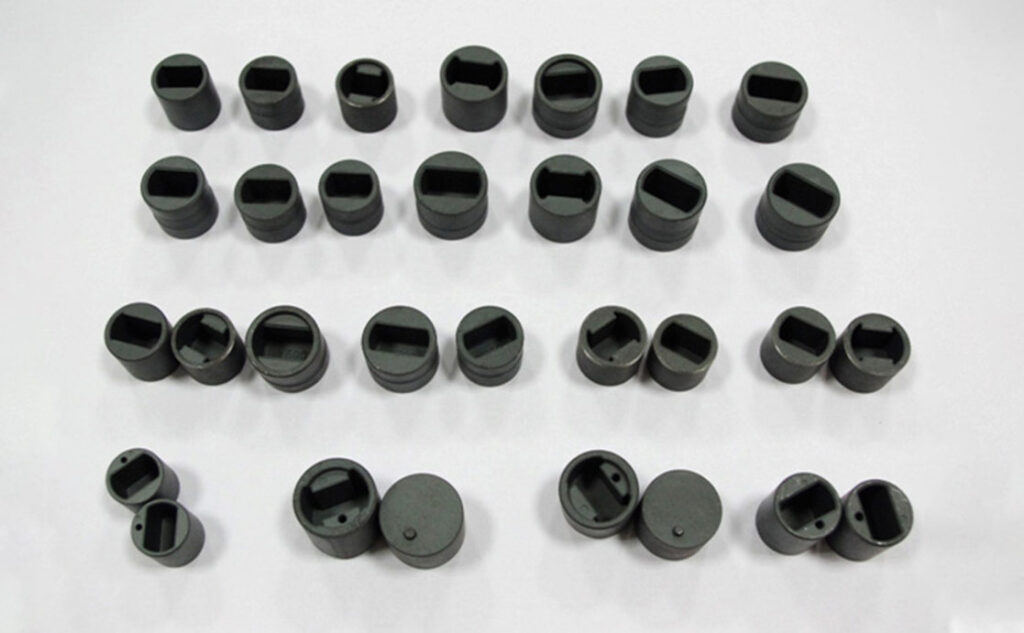

Production of Air Compressor Piston by Powder Metallurgy
Air compressor pistons made by powder metallurgy start with a blend of metal powders and binders. This mixture provides better flow and compaction. Mixed powders are then compacted in a precision die to form the piston shape, including the skirt, crown, and internal features. Compaction pressures typically range from 400 to 800 MPa to achieve the required density.
The compacted piston, known as a green compact, is then sintered at high temperature. Sintering bonds the metal particles and provides the strength, dimensional stability, and wear resistance needed for continuous compressor operation. The pore structure and final density can be controlled to balance strength and weight.
After sintering, secondary operations may be applied. These include sizing to correct dimensions, CNC machining for pin bores or critical sealing areas, and heat treatment to improve fatigue and wear performance. Steam treatment or surface coating can also be used to enhance corrosion resistance and hardness.
How an Air Compressor Piston Work?
An air compressor piston operates by converting the rotational motion of the crankshaft into linear motion inside the cylinder. As it moves downward, the pressure in the cylinder drops and air is drawn in through the intake valve. When the piston moves upward, the trapped air is compressed and pushed through the discharge valve into the outlet system.
The piston functions together with the rings, connecting rod, and cylinder to maintain a sealed chamber during compression. Effective sealing and precise movement are essential because they influence volumetric efficiency, pressure stability, and overall compressor performance. Continuous cyclic loading requires the piston to maintain accurate alignment and stable sliding contact.


Advantages of Sintered Air Compressor Piston
Sintered air compressor pistons offer several advantages due to the powder metallurgy process. The PM process forms complex geometries with accurate dimensions, which reduces machining requirements and supports consistent quality in high-volume production.
Sintered materials exhibit uniform density, stable mechanical properties, and good wear resistance. These properties are important for continuous sliding contact inside the cylinder. Controlled porosity can also improve lubrication behavior and reduce friction in specific piston designs.
Powder metallurgy produces pistons with predictable weight and balance. This contributes to stable compressor operation, lower vibration, and reliable performance in both lubricated and oilless reciprocating compressors.
Access Your Air Compressor Piston!