



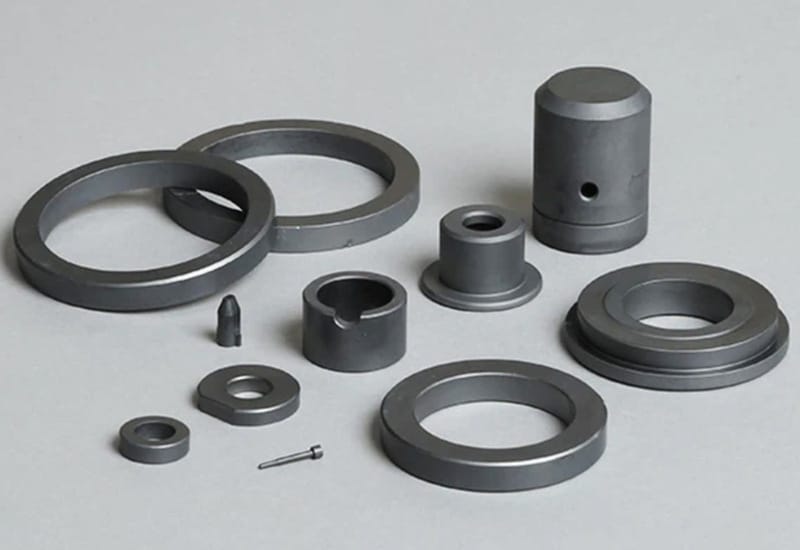
Sintered silicon nitride (SSN) is a high-performance structural ceramic material. It has a low density and a significantly high level of thermal-shock resistance, wear resistance, and good fracture toughness. As a result, components manufactured with SSN support reliable performance in environments including rapid temperature cycling, mechanical loading, and abrasive contact. This makes it an important component in arduous automotive, aerospace, electronic, and industrial applications.
Contents
What is Sintered Silicon Nitride?
Sintered silicon nitride (SSN) is a product of compacting fine silicon nitride powder with binders. The green compact is then sintered under a controlled atmosphere to form a dense polycrystalline body. The additives facilitate sintering that occurs in the liquid phase, and the atmosphere (normally high-pressure N₂) avoids degradation of sintered silicon nitride in the high-temperature cycle. Common processing temperatures of SSN are in the ~1750–2080 °C range, depending on the path.
The densities and strengths of contemporary sintered bodies are comparable to those of hot-pressed versions, and are also cheaper to manufacture, compared to previous sintered silicon nitride materials.
Types of Sintered Silicon Nitride
Silicon nitride materials are generally differentiated by their processing pathway; a pathway produces a somewhat different microstructure and balance of properties.
Reaction Bonded Silicon Nitride (RBSN)
Prepared by means of nitriding silicon compounds (Si → Si₃N₄) at an approximate temperature of 1400 °C (2552 °F). Reaction bonded silicon nitride does not reduce much in processing, and thus it is applicable in near-net shape parts and components where control of dimensions is important.
During the reaction, nitrogen diffuses into the porous silicon compact and converts part of the silicon into silicon nitride, thereby bonding the structure without applying external pressure.
Because the reaction-bonding route avoids costly diamond-grinding steps. So, RBSN components can be produced at a significantly lower cost than many fully densified silicon nitride grades. Even with a typical porosity level of 20–30%, the material delivers strong mechanical performance, commonly achieving flexural strengths in the range of 200–400 MPa.
Hot Pressed Silicon Nitride (HPSN)
Hot pressed silicon nitride ceramics are produced by applying simultaneous high temperature and uniaxial pressure, yielding a near-theoretical dense microstructure with minimal porosity and glassy binder phase. Because of this, compared to gas-pressure sintered silicon nitride, the hot pressed silicon nitride variant exhibits superior mechanical and thermal properties. Hot pressed silicon nitride shows flexural strength in the range of 900 MPa,density g/cm3 3.2~3.4, and hardness around ~17 GPa.
Its thermal conductivity is also significantly higher, 23~25 W/m·K, while sustaining service temperatures above 1,300 °C in inert atmospheres. Because of its processing complexity and cost, HPSN is reserved for high-end, specialized parts such as aerospace turbine components, high-precision bearings, and high‐power electronic substrates.
Pressureless Sintered Silicon Nitride (SSN)
In pressureless sintering, compacts are heated in the presence of nitrogen (or in a powder bed) under no pressure. Although the forming step is simpler than hot pressing, the overall sintering route requires complex, high-temperature equipment and can be costly. The process also exhibits a large linear shrinkage (up to ~20%), which can introduce cracking or dimensional deformation if not controlled.
It has good strength, resistance to oxidation, and fracture toughness because its strong covalent bonding provides high mechanical strength. Formation of a stable silica layer on its surface prevents further oxidation, and its interlocking grain structure helps deflect cracks and improve toughness.
This is because dense polycrystalline microstructure, reinforced by elongated β-Si₃N₄ grains and a well-controlled secondary phase. Typical sintering temperatures are 1750 °C and higher.

Sintered Reaction-Bonded Silicon Nitride (SRBSN)
Sintered reaction-bonded silicon nitride (SRBSN) is produced by adding appropriate sintering aids to reaction-bonded silicon nitride followed by a high-temperature densification step, typically between 1780 °C and 2000 °C under an overpressure of nitrogen.
The process yields articles with very low sintering shrinkage (approximately 5 – 10 %), which facilitates near-net shape fabrication.
Two SRBSN systems containing MgO and Y₂O₃ additives have been shown to achieve microstructure and properties comparable to corresponding hot-pressed Si₃N₄ systems.
These characteristics make SRBSN an attractive route when minimal dimensional change and high ceramic properties are required in structural components. 3
Gas Pressure Sintered Silicon Nitride (GPSSN)
The gas-pressure sintering process enables fabrication of highly dense, near-pore-free Silicon nitride ceramics while using minimal sintering additives. These compacts exhibit high strength, excellent reliability, and very good heat resistance.
Gas pressure sintered silicon nitride components have been applied in demanding environments such as turbocharger rotors in automotive engines, cutting tools, and bearing balls for industrial use, reflecting the material’s suitability for high-performance and high-reliability structural parts.
Properties of Sintered Silicon Nitride
Sintered silicon nitride is an amalgamation of a collection of mechanical, thermal, and chemical properties that prove its broad application:
| Property | Value |
|---|---|
| Density | ~3.28 g·cm⁻³ |
| Elastic Modulus | ~285 GPa |
| Flexural/Bend Strength | Typically, in the hundreds of MPa (≈675 MPa common value) |
| Fracture Toughness (K₁C) | ~6 MPa·m0.5 |
| Hardness | ~16 GPa |
| Thermal Shock Resistance | Excellent |
| Oxidation Resistance | Excellent |
| Decomposition Temperature | ~1900 °C |
| Thermal Conductivity | 25 W/m·K |
These nominal values, density, modulus, strength, toughness, hardness, and decomposition temperature are typical of modern sintered silicon nitride alloys. They help explain why fully dense silicon nitride often outperforms bearing steels in rolling-contact fatigue and high-speed rotating applications. Its lower density reduces centrifugal forces and contact stresses, while its high fatigue resistance allows it to withstand repeated loading without failure. Together, these properties significantly decrease thermal and mechanical stresses under high rotational speeds.
Applications of Sintered Silicon Nitride
Automotives
Applied to rotating parts of reciprocating engines, turbocharger rotors (lower inertia reduces lag), bearings, rocker pads, glow-plug hardware, and exhaust gas control hardware. The low density of the material minimizes centrifugal stresses in rotating components, and its thermal and wear resistance prolongs component life.
Electronics
Silicon nitride is an electrical insulator and a diffusion barrier in microelectronics (passivation layers, dielectric barriers) and is applied in protective package substrates where water and sodium diffusion needs to be restricted. Its moderate dielectric constant and low radio-frequency loss are appealing to radio-frequency devices; its elasticity and stability are useful in microelectromechanical sensing devices, such as in cantilevers in atomic force microscopy.
Optics & Photonics
Silicon nitride has applications in integrated photonics (Si₃N₄ photonics) due to its broadband transparency (visible to mid-IR), low loss, and compatibility with semiconductor fabrication. It facilitates biophotonic sensors, telecom/data communications waveguides, optical signal processing, and sensing.
Welding Industry
Such steel parts as welding rollers are being substituted with advanced silicon nitride ceramics. Because it has better wear resistance, thermal-shock resistance, and longer high-thermal-cycling service.
BLUE Powder Metallurgy is your trusted manufacturer sintered ceramics. We provide a full range of sintered ceramic components made from silicon nitride, alumina, zirconia, or silicon carbide. Each sintered ceramic part is produced with strict quality control to deliver stable performance and long service life. When you need high quality sintered ceramic parts, we make it happen.